
B2 First Reading & Use of English Part 5
Multiple choice
What is Part 5 Multiple choice?
One longer text of around 500-600 words with 6 multiple-choice questions.
What it tests
1. Reading for detail
Description:
Find specific information in the text. This usually involves facts, figures, or small details that are explicitly stated.
Example:
The museum opens at 9 a.m. every day except Mondays.
Question:
What time does the museum open on Saturdays?
A 8 a.m. B 9 a.m. C 10 a.m. D 11 a.m.
Answer: B 9 a.m.
The answer is stated directly in the text.
2. Opinion and attitude
Description:
Understand how the writer or a character feels about something. Look for words that show emotions, preferences, or opinions.
Example:
The author seems unhappy with the new regulations, describing them as “unnecessarily complicated.”
Question:
How does the author feel about the new regulations?
A They are excellent
B They are frustrating
C They are irrelevant
D They are inspiring
Answer: B They are frustrating
“Unnecessarily complicated” signals negative opinion.
3. Main ideas
Description:
Understand the general meaning or key point of a paragraph or text. Sometimes you must summarise what a section is about.
Example:
Urban gardens are becoming increasingly popular because they provide fresh food, green space, and a sense of community in cities.
Question:
What is the main idea of the paragraph?
A Urban gardens are easy to maintain
B Urban gardens are a popular solution in cities
C Urban gardens are expensive
D Urban gardens are rare
Answer: B Urban gardens are a popular solution in cities
The paragraph lists benefits → general main idea.
4. Inference
Description:
Understand something not directly stated. You need to read between the lines and use context to figure out the meaning.
Example:
After several failed attempts, Mia finally managed to bake a perfect sourdough loaf.
Question:
What can we infer about Mia?
A She is a professional baker
B She had difficulties before this success
C She doesn’t like bread
D She gave up trying
Answer: B She had difficulties before this success
“Several failed attempts” implies she struggled before succeeding.
Suggested strategy
-
Read the questions first
-
Find the relevant section of the text
-
Justify your answer with evidence from the text
Common mistakes
-
Choosing answers that are almost correct
-
Using background knowledge instead of the text
-
Reading too fast
Part 5 Multiple Choice Format
Answers to this sample can be found in the interactive exercise below.
Interactive exercise with answers
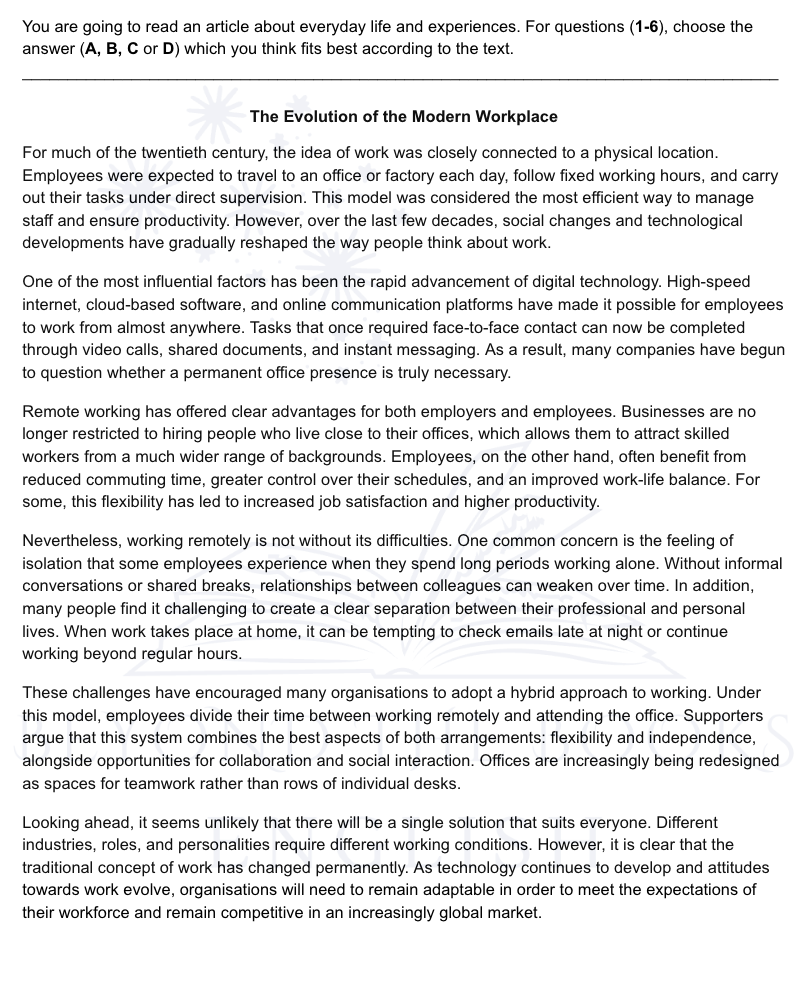
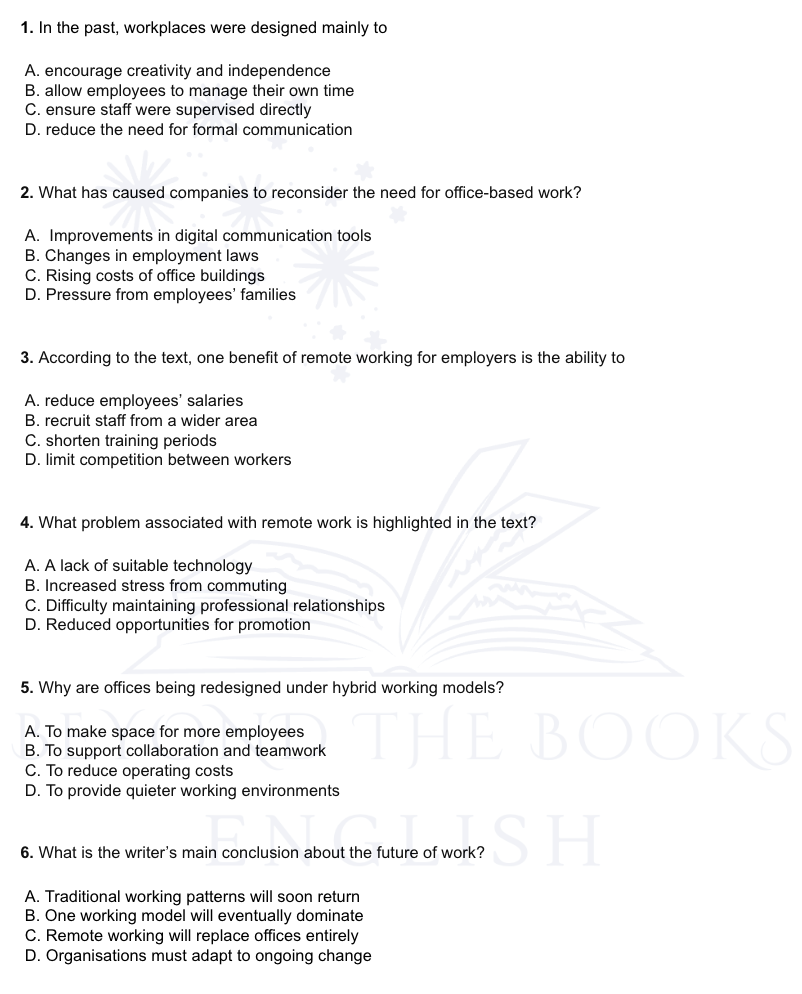
You are going to read an article about everyday life and experiences. For questions (1-6), choose the answer (A, B, C or D) which you think fits best according to the text.
__________________________________________________________________________________________________________________
The Evolution of the Modern Workplace
For much of the twentieth century, the idea of work was closely connected to a physical location. Employees were expected to travel to an office or factory each day, follow fixed working hours, and carry out their tasks under direct supervision. This model was considered the most efficient way to manage staff and ensure productivity. However, over the last few decades, social changes and technological developments have gradually reshaped the way people think about work.
One of the most influential factors has been the rapid advancement of digital technology. High-speed internet, cloud-based software, and online communication platforms have made it possible for employees to work from almost anywhere. Tasks that once required face-to-face contact can now be completed through video calls, shared documents, and instant messaging. As a result, many companies have begun to question whether a permanent office presence is truly necessary.
Remote working has offered clear advantages for both employers and employees. Businesses are no longer restricted to hiring people who live close to their offices, which allows them to attract skilled workers from a much wider range of backgrounds. Employees, on the other hand, often benefit from reduced commuting time, greater control over their schedules, and an improved work-life balance. For some, this flexibility has led to increased job satisfaction and higher productivity.
Nevertheless, working remotely is not without its difficulties. One common concern is the feeling of isolation that some employees experience when they spend long periods working alone. Without informal conversations or shared breaks, relationships between colleagues can weaken over time. In addition, many people find it challenging to create a clear separation between their professional and personal lives. When work takes place at home, it can be tempting to check emails late at night or continue working beyond regular hours.
These challenges have encouraged many organisations to adopt a hybrid approach to working. Under this model, employees divide their time between working remotely and attending the office. Supporters argue that this system combines the best aspects of both arrangements: flexibility and independence, alongside opportunities for collaboration and social interaction. Offices are increasingly being redesigned as spaces for teamwork rather than rows of individual desks.
Looking ahead, it seems unlikely that there will be a single solution that suits everyone. Different industries, roles, and personalities require different working conditions. However, it is clear that the traditional concept of work has changed permanently. As technology continues to develop and attitudes towards work evolve, organisations will need to remain adaptable in order to meet the expectations of their workforce and remain competitive in an increasingly global market.